
🔖𝙏𝒊𝙜𝒓𝙖𝒊 𝑾𝙚𝒆𝙠𝒍𝙮 𝘿𝒊𝙜𝒆𝙨𝒕

𝓔𝒏𝓭𝒊𝒏𝓰 March 3, 𝟐𝟎𝟐6
𝐴 𝑏𝑙𝑜𝑔 𝑤𝑜𝑣𝑒𝑛 𝑤𝑖𝑡ℎ ℎ𝑢𝑚𝑎𝑛-𝑐𝑒𝑛𝑡𝑒𝑟𝑒𝑑 𝑠𝑡𝑜𝑟𝑖𝑒𝑠 𝑜𝑏𝑗𝑒𝑐𝑡𝑖𝑣𝑒 𝑖𝑛𝑠𝑖𝑔ℎ𝑡𝑠, 𝑎𝑛𝑑 𝑜𝑟𝑖𝑔𝑖𝑛𝑎𝑙 𝑝𝑒𝑟𝑠𝑝𝑒𝑐𝑡𝑖𝑣𝑒𝑠 —𝑧𝑜𝑜𝑚𝑖𝑛𝑔 𝑖𝑛 𝑜𝑛 𝐓𝐢𝐠𝐫𝐚𝐢 𝑤𝑖𝑡ℎ𝑖𝑛 𝑡ℎ𝑒 𝑤𝑖𝑑𝑒𝑟 𝐄𝐭𝐡𝐢𝐨𝐩𝐢𝐚𝐧 𝑐𝑎𝑛𝑣𝑎𝑠.Adwa: The Big Picture and Its Tensions
Dear Subscribers,
I am happy to share with you my updates and reflections on four related topics that have surfaced this week in Ethiopia in general, and in Tigray in particular. I hope you will benefit from reading them. Please send your feedback as usual.
Adwa: The Big Picture and Its Tensions
This week’s celebration of the Victory of Adwa was conducted on an unusually large scale. Radio and television stations in the capital provided continuous coverage. Artistic performances, public lectures, and historical references dominated the media space. The traditional laying of wreaths and national addresses included an extensive list of dignitaries — former presidents, a former prime minister, and senior public figures — so numerous that the formal acknowledgments alone took considerable time at each podium.
March 2 remains a singular date in Ethiopian history. The victory at the Battle of Adwa stands as a defining moment in which Ethiopian forces defeated an invading Italian army. Its significance has never been in doubt.
Yet, beneath the celebration lies a long-standing tension — one that has grown more pronounced in recent years. The debate concerns attribution: who played the decisive role, which commanders bore the greater burden, which cavalry units or infantry divisions turned the tide. The campaign involved multiple leaders from different parts of the country. Over time, some names were amplified while others receded. This pattern is not unique to Adwa; Ethiopian historiography has often reflected the priorities of those in power, with official chroniclers tending to elevate the reigning monarch while minimizing contributions from others.
Another enduring point of contention concerns whether Ethiopian forces, under Menelik II, should have pursued the retreating Italians further and expelled them from the coastal territories, including Massawa. One school of thought argues that Menelik was constrained by prior diplomatic engagements, notably the Treaty of Wuchale, and subsequent correspondence that complicated Ethiopia’s position regarding Italian claims in Eritrea. Others suggest more practical limitations: exhaustion, stretched logistics, and the risk that overextension might have jeopardized the victory already secured.
Whatever interpretation one adopts, Adwa produced a dual legacy. It symbolized the capacity of an African state to defeat a European colonial power. At the same time, it coincided with the consolidation of Eritrea as an Italian colony — a development whose long-term consequences shaped the region for decades.
Turning to the present, this year’s commemoration in Adwa town itself was conducted without representation from the federal government — a notable departure from earlier practice, when senior officials from Addis Ababa typically attended and sometimes served as guests of honor. The absence was widely observed.
At the same time, the narrative surrounding Adwa continues to evolve. In Adwa town and across Tigray, there is an increasing emphasis on local ownership of the history of the campaign. The argument, implicit or explicit, is that earlier national narratives disproportionately centralized certain figures while underrepresenting others. The current trend seeks to recalibrate that historical balance.
Yet beyond questions of narrative and political positioning lies a more immediate concern: Adwa as a town. For all the national symbolism attached to its name, the town itself remains underdeveloped. Commemoration, amplified rhetoric, and competing historical claims do not automatically translate into tangible benefit for its residents. If Adwa is to remain central to Ethiopia’s historical consciousness, then its custodians — the people who live among its landscapes, artifacts, and oral traditions — should share in that legacy in concrete ways.
Historical pride alone is insufficient. The town of Adwa, like many others, requires sustained investment, preservation of heritage sites, and economic opportunity. Otherwise, the celebration risks becoming detached from the lived reality of the place whose name it invokes.
Adwa belongs to national history. But it is also a local community. The two should not be separated.
Tigray Needs Guarantees, Not Gestures
For the first time in Ethiopia’s modern history, the country has a prime minister who speaks the three most widely used national languages: Amharic, Afaan Oromo, and Tigrigna. This week, Abiy Ahmed gave an interview in Tigrigna. The gesture was notable and deserves acknowledgment. Communicating in a community’s own language carries symbolic weight and signals recognition.
Yet symbolism, however welcome, cannot substitute for policy.
For many in Tigray, the dominant concern is not linguistic outreach but security and stability. The persistent fear of renewed conflict continues to shape daily life. The possibility of another military confrontation remains the most destabilizing factor in the region. Businesses hesitate to invest. Professionals reconsider long-term plans. Young people leave in significant numbers, driven in part by fear and in part by declining confidence in institutional recovery.
Economic constraints compound this insecurity. Limitations on banking services, severe fuel shortages across towns, scarcity of essential medicines, and the prolonged closure of major arterial roads connecting Tigray to the rest of the country have created a sense of suffocation. These are not abstract grievances; they directly affect livelihoods, mobility, and access to basic services.
In this context, rhetorical exchanges — whether critical of the TPLF or defensive of federal policy — are unlikely to reassure the public. What would carry greater weight are concrete measures: restoring full banking operations, ensuring regular fuel and medical supplies, reopening transport corridors, and offering clear, credible guarantees against renewed military action.
Language matters. Representation matters. But durable stability depends on tangible steps that reduce uncertainty and rebuild trust.
If the objective is national cohesion, then policy clarity and practical action must follow symbolic outreach. Only then can reassurance become credible, and only then can recovery take root.
Tsimdo and the Question of Reliability
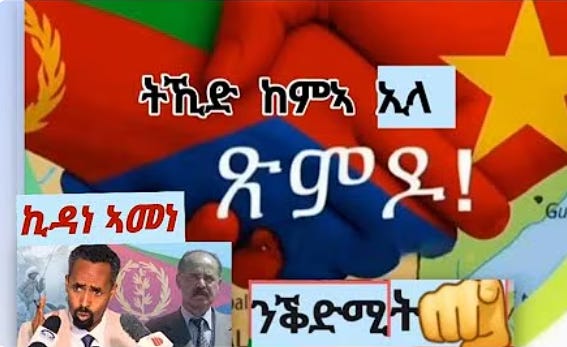
The national demonstrations held across Tigray towns on Friday, 27 February, denouncing the decision of the National Electoral Board to remove five electoral districts from Tigray, were timely and well attended. The message was clearly articulated. Yet the event received little to no coverage in federal or major private media outlets. Regardless of media silence, the demonstration conveyed a direct rejection of decisions taken by two federal institutions: the House of Federation and the National Electoral Board.
One of the most notable speeches came from ‘opposition’ figure Kidane Amene. In recent months, he has become increasingly vocal, presenting himself as a defender of sovereignty and national dignity, though without openly calling for war. More significantly, he articulated explicit support for what is described as “Tsimdo” — an active partnership with the Eritrean government — framed as a counterweight to the administration of Abiy Ahmed and what he portrays as the threat it represents.
In his address, Kidane underscored that this proposed alignment is concrete and deliberate, suggesting that it goes further and is more openly declared than previously articulated by leaders within the TPLF.
Kidane also sharply criticized Tigrayans working with the federal government in Addis Ababa, accusing them of undermining the regional administration and the interests of Tigray. His language was direct and uncompromising.
What stood out most, however, was the strong endorsement of closer collaboration with Eritrea. The argument presented was that such alignment has deterred planned federal military action and that Tigray is no longer isolated in facing external threats. In parallel, Colonel Gebre Gebre-Tsadik referred to Eritrea’s long war of independence, emphasizing sacrifice and resilience, and dismissing federal territorial claims as irredentist.
This raises a fundamental question: on what basis should a strategic alliance with the Eritrean government be evaluated?
Any partnership, even a tactical one, must be assessed against historical experience and institutional conduct. The record of relations between the Eritrean leadership and Tigray — particularly during periods of conflict — is complex and deeply contested. It includes episodes of cooperation, but has been largely mired in confrontation and mistrust. That history cannot be overlooked when discussing future alignment.
Defending Tigray’s interests and addressing legitimate security concerns is one matter. Anchoring strategy in durable principles and long-term interests is another. Strategic alliances may be necessary in certain contexts, but they require sober assessment, clarity of objectives, and realistic expectations.
Tigray’s future security and stability should rest primarily on internally coherent policy, institutional strength, and sustainable political solutions. Engagement with Eritrea need not be antagonistic. However, basing Tigray’s security on a political narrative that is highly dubious and tries to sideline memories of being let down is dangerous.
The central issue, therefore, is not emotion but reliability, consistency, and long-term interest. Alliances are not built on urgency alone; they endure only when grounded in mutual trust and predictable conduct.
Injunction, Institutions, and Political Calculus
The federal court’s injunction suspending the National Electoral Board’s decision has been a central development of the week. Getachew filed suit on behalf of the Simret Party, challenging the Board’s move to remove five electoral districts from Tigray. The court issued a temporary order halting the decision until the Board presents its defense.
Formally, this is a legal process: an administrative decision challenged, judicial review sought, and implementation paused. The Board must now justify the necessity and legality of its action.
Beyond the formal process, there is a political reading that cannot be ignored. It is difficult to assume that a decision of this magnitude — reinforced by the House of Federation — occurred without at least tacit approval from Prime Minister Abiy Ahmed. Federal institutions do not operate in a vacuum, especially on matters touching sensitive territorial questions.
From this perspective, the Board’s decision may reflect a broader federal calculation regarding the so-called “contested areas.” The backlash from Tigray — both within the region and across the diaspora — appears to have altered the immediate trajectory. The court injunction may serve more than a procedural purpose: it provides a pause, creates space, and offers a face-saving mechanism through which implementation can be delayed without formal reversal.
As for Getachew, the sequence of events suggests the decision may not have been anticipated. His immediate response indicates to me genuine surprise. If coordination with the premier had existed beforehand, his reaction might have been more measured. None of this can be conclusively proven, but in Ethiopian politics, legal and political tracks often move together.
The broader institutional question remains. In Ethiopia’s constitutional framework, interpretation of disputes involving federal institutions ordinarily falls to the House of Federation, supported by the Council of Constitutional Inquiry. That raises a complexity here, since the House has already taken a position on the contested territories. When an institution is substantively involved, its neutrality is naturally in question.
A more fundamental issue is whether the Electoral Board possesses the authority to alter electoral boundaries in ways that affect regional borders. Electoral districts are expected to correspond to constitutionally recognized regions. The court’s intervention preserves the status quo while creating breathing space amid rising tensions.
The intensity of reaction within Tigray suggests the decision carried a high political cost. In that context, judicial suspension may function as a temporary de-escalation, whether intended or incidental. Whatever the motivations, the injunction is a pause: implementation is halted, but the substantive debate remains unresolved. Resolution will require reference to the Constitution and the Pretoria Agreement, both of which clearly define territorial arrangements. Territories declared part of Tigray shall remain so unless a duly conducted referendum decides otherwise.
The next phase is likely to shift from courtroom argument to political mobilization. Sustained opposition — across parties, civic actors, and institutions — will require coordination beyond partisan lines. On issues involving territorial and constitutional questions, leadership cannot rest solely with one party. Broader alignment is essential to influence federal recalculation and redirect international attention to this unresolved matter.