
🔖𝙏𝒊𝙜𝒓𝙖𝒊 𝑾𝙚𝒆𝙠𝒍𝙮 𝘿𝒊𝙜𝒆𝙨𝒕
𝓔𝒏𝓭𝒊𝒏𝓰 March 9, 𝟐𝟎𝟐6

𝐴 𝑏𝑙𝑜𝑔 𝑤𝑜𝑣𝑒𝑛 𝑤𝑖𝑡ℎ ℎ𝑢𝑚𝑎𝑛-𝑐𝑒𝑛𝑡𝑒𝑟𝑒𝑑 𝑠𝑡𝑜𝑟𝑖𝑒𝑠 𝑜𝑏𝑗𝑒𝑐𝑡𝑖𝑣𝑒 𝑖𝑛𝑠𝑖𝑔ℎ𝑡𝑠, 𝑎𝑛𝑑 𝑜𝑟𝑖𝑔𝑖𝑛𝑎𝑙 𝑝𝑒𝑟𝑠𝑝𝑒𝑐𝑡𝑖𝑣𝑒𝑠 —𝑧𝑜𝑜𝑚𝑖𝑛𝑔 𝑖𝑛 𝑜𝑛 𝐓𝐢𝐠𝐫𝐚𝐢 𝑤𝑖𝑡ℎ𝑖𝑛 𝑡ℎ𝑒 𝑤𝑖𝑑𝑒𝑟 𝐄𝐭𝐡𝐢𝐨𝐩𝐢𝐚𝐧 𝑐𝑎𝑛𝑣𝑎𝑠.Adwa: The Big Picture and Its Tensions
Dear Subscriber readers,
I am pleased to return with my narration of developments this week, accompanied by personal reflections. I have selected four topics that I believe are both relevant and worthy of discussion.
First, is the recent signature of a partnership between four Tigrean political parties a meaningful step toward unity, or is it merely symbolic? Second, what is the situation in Tigray regarding basic services and amenities—and how are ordinary citizens faring under current conditions? Why is the federal administration seemingly intent on choking the population’s access to vital resources and amenities? Third, what are the legal and constitutional ramifications of the handling of the electoral dispute by the courts, particularly in light of Daniel Fekadu’s analysis?
Beyond these systemic and institutional questions, personalities that shape public discourse deserve attention. Are we sufficiently recognising and supporting the young politician, Mistre-Silassie, who courageously spoke the truth about Tigray? Conversely, how should we regard Dagnachew Assefa, whose vulgar, unrestrained remarks have revealed the moral degradation that can accompany proximity to power?
These are the topics I have handled. Have a good read. Thanks for your support.
1. Unity in Tigrai: Partnership or a Narrow Circle?
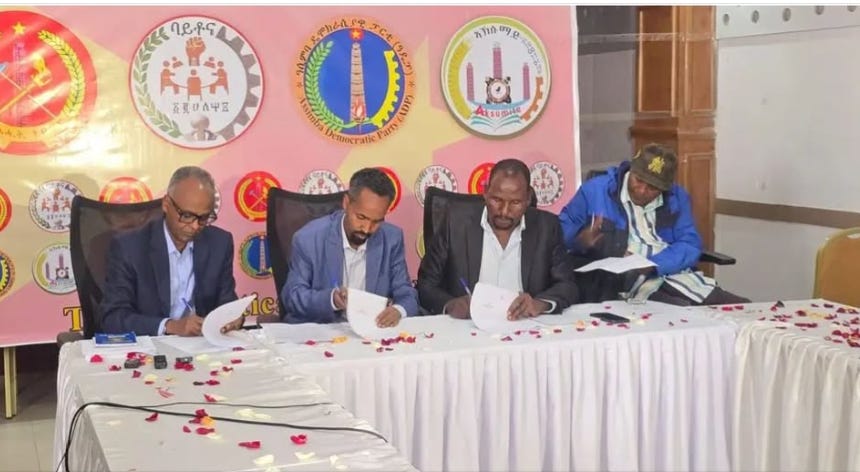
We have just witnessed four political organisations in Tigrai sign a partnership agreement—TPLF, Axumite, Baitona, and Asimba—pledging to work together to advance the interests of Tigrai and to fend off any imminent or potential threats facing the region.
At a time when the pressure around Tigrai appears to be tightening, it is difficult to oppose cooperation in principle. The region stands under a growing noose, and any effort that seeks to strengthen collective resolve deserves attention. Yet the partnership, as it stands, is markedly selective. It brings together only a cluster of like-minded organizations whose political outlooks on Tigrai are largely similar.
This naturally raises a question: what about the others? Where do parties such as Salsay Woyane and Arene fit within this vision? If the frequently invoked call for the unity of Tegaru is to take genuine root, it cannot remain confined to those who already share similar perspectives. Unity must reach across the spectrum of political persuasions.
If the objective is truly to cement unity, it must be demonstrated in action. That means building a broad-based governing arrangement capable of marshalling the resources, legitimacy, and collective will of the entire society. Tigrai today faces an exceptional moment in its history. It is hardly a time to continue leaning on the mandate claimed from the September 2020 election—an election that turned out to be controversial and whose political relevance was later overtaken by the Pretoria Agreement and the events that followed.
Any governing arrangement in Tigrai at this juncture must therefore be transitional and consensual in nature. No single organisation—including the TPLF—should claim to monopolise power or assume a dominant share as a matter of entitlement. If the TPLF indeed commands the popularity it often asserts, the most straightforward way to demonstrate that claim would be through a future election conducted under broadly accepted conditions.
For now, the moment calls for something different: a government of consensus, reflecting the participation of the wider political and social spectrum.
True unity is not forged through selective partnerships, nor through the habit of dismissing dissenting voices as the “other.” It emerges through inclusion, participation, and a willingness to accommodate different currents within the Tigrean political landscape.
Most importantly, genuine unity must begin with one decisive step: the abrogation of the military-political alignment declared in January 2025, which effectively placed sections of the military on the side of the faction that conducted the August 2024 party congress. The irony is difficult to overlook. The remaining military structure in Mekelle aligned itself with a congress widely viewed as impaired—one that key institutions connected to electoral legitimacy had already rejected.
Once again, if unity is truly the goal, the path toward it must begin not with selective alliances, but with inclusive politics and the clear separation of military power from partisan contestation.
2. Essential Services as a Leverage and Viciously: The Growing Strain on Tigrai
What is currently unfolding in Tigrai with regard to the provision of basic government amenities and essential supplies has become deeply alarming. The situation has moved beyond mere administrative failure. Increasingly, it appears that essential public services are being used as instruments of pressure against a population already stretched to its limits.
Take fuel as one example. In Mekelle today, a litre of fuel sells for between 350 and 400 birr, roughly three times the price in Addis Ababa. More troubling still is the source of the supply. Much of the fuel circulating in the city is obtained through informal or contraband channels. In effect, a critical commodity—one that can only be legally distributed with the sanction of the federal authorities—has been allowed to slip into a shadow market.
The implications for everyday life and economic activity are severe. Transport costs soar, businesses struggle to operate, and ordinary citizens are forced to pay exorbitant prices simply to move about their daily lives. An economy cannot function normally under such conditions.
The issue does not stop with fuel. Another equally disturbing development concerns the payment of salaries to government civil servants. The regional administration under President General Tadesse Worede recently announced that government employees would not receive their salaries for the month of Yekatit (February). In effect, tens of thousands of civil servants—teachers, health workers, and administrators—have been denied the income upon which their families depend.
The explanation provided is that budget transfers from the federal government are arriving only in small tranches and are insufficient to cover the payroll. If this is indeed the case, the question that naturally arises is: how can such a situation be justified?
The federal government bears a fundamental responsibility toward all citizens of the country. When the flow of essential fiscal support becomes erratic or inadequate, the consequences fall not on political actors but on ordinary people trying to sustain their livelihoods.
Tigrai, often described as one of the historic cradles of the Ethiopian state, is today enduring immense hardship. Economic stagnation, scarcity of key commodities, and uncertainty about basic incomes are pushing many young people to leave their homeland in search of survival elsewhere. The resulting out-migration is steadily draining the region of its most vital human resource.
At moments like this, the call for unity among Tigreans becomes not a rhetorical aspiration but a practical necessity. A collective voice must be raised—calmly but firmly—to draw attention to the realities on the ground.
If the federal authorities believe that commodities such as fuel or budget allocations are being diverted for improper purposes, the responsible course of action would be to present evidence publicly and explain measures to be taken. Transparency would serve everyone’s interests.
What cannot be justified, however, is a situation in which an entire civilian population bears the burden of deprivation while questions remain unanswered.
The people of Tigrai are not abstractions in a political contest. They are citizens struggling, often precariously, to sustain daily life. Policies that deepen that struggle—whether through neglect or deliberate restriction—deserve scrutiny and an honest national conversation.
3. Judicial Oversight and Electoral Boundaries: Reflections on Daniel Fekadu’s Analysis
A lawyer by the name of Daniel Fekadu has recently published a long and carefully reasoned article on Meseret Media’s Substack examining the controversy surrounding the National Electoral Board’s decision to detach five electoral zones from Tigrai and place them under federal electoral administration. The decision effectively removes these constituencies from the region’s electoral framework and places them directly under federal institutions.
Daniel’s article offers a detailed legal analysis of the rationale behind this move—or the possible lack thereof—and explores its broader jurisprudential implications for Ethiopian constitutional law.
The issue has now entered a new phase with the filing of a case by the Simret Party challenging the decision. Daniel argues that this development should be welcomed. Bringing the matter before the courts opens the door for judicial interpretation at the highest level and may contribute to the evolution of Ethiopian constitutional practice.
His argument rests on two central propositions.
First, courts possess an inherent authority to review the actions of legislative bodies and their institutional extensions—such as the Electoral Board—when the decisions of those bodies affect the fundamental rights of citizens. Judicial oversight in such circumstances is not an intrusion into the legislative domain but an essential safeguard within a constitutional order.
Second, judicial scrutiny becomes particularly necessary when public institutions appear to act ultra vires—that is, beyond the scope of their lawful mandates. In Daniel’s assessment, both the House of Federation and the Electoral Board may have ventured into precisely such territory by issuing decisions that effectively reconfigure electoral jurisdictions.
At stake is not merely an administrative or procedural matter. Decisions that redefine electoral constituencies inevitably affect the ability of citizens to exercise one of their most basic democratic rights: the right to vote and to participate meaningfully in the political process. When such rights are materially affected—or even carry the potential of being affected—the courts have both the jurisdiction and the duty to examine whether the actions taken were lawful.
Whether one ultimately agrees with every element of Daniel’s reasoning or not, his article provides a thoughtful and instructive exploration of the constitutional principles involved.
My own reflection on the matter is this.
Many observers suspect—perhaps not without reason—that the Electoral Board’s decision carries a strong political undertone. It appears, to many perhaps even to most, as an attempt by the federal government to influence the future political trajectory of these areas away from Tigrai.
Yet suspicion alone cannot be the basis for a response.
Issues of this nature must be approached on multiple fronts: legal, political, and civic. If institutions have indeed acted beyond their mandates, the appropriate course is to challenge those actions through lawful mechanisms and reasoned argument. Doing so serves not only the immediate dispute but also the long-term integrity of the constitutional system.
By choosing the path of legal contestation and civic engagement, we demonstrate something essential about who we are as a people. We show the world—and ourselves—that our instinct is to pursue justice through institutions and rational discourse rather than confrontation.
This is not to suggest any naïve belief in the absolute impartiality of institutions. Ethiopia’s institutional landscape has deep limitations, and no serious observer ignores those realities. Nevertheless, it remains important to use every available avenue—legal, political, and civic—in a coordinated effort to advance our case and defend our rights.
The legal challenge initiated by the Simret Party should therefore be seen as one possible avenue among several. It does not foreclose Tigrai’s broader case. That case remains deeply embedded in constitutional principles, in fairness, and in the commitments reflected in internationally observed agreements. Simret’s initiative simply represents one mechanism through which the issue can be tested and kept alive within the legal arena.
The bottom line remains that going to battle is never the preferred choice. The enduring inclination, whenever possible, has to be to argue our case, defend our rights, and pursue resolution through civilised means—including legal advocacy and political alignment with national actors who understand and sympathise with our position.
This is particularly important at the current time when Tegaru hugely believe that Tigrai is being blatantly denied the very sovereignty that the constitution—and a peace agreement observed by the international community—recognised and affirmed.
For readers interested in the legal dimensions of the current electoral boundary dispute, Daniel Fekadu’s article offers a thoughtful and instructive contribution to the debate.
The link to the article is provided below.
የምርጫ ቦርድ ውሳኔ መታገድ የፌዴሬሽን ምክር ቤት ውሳኔ ላይ ያለው የህግ አንድምታ
4. A Voice of Conscience in the Political Debate: Mistre-Silassie
A new voice has recently emerged in Ethiopia’s political debate. A young woman by the name of Mistre-Silasse Tamru has entered the public conversation through media discussions examining the political positions and standing of various parties. It will be amiss for me not to write about her here.
Mistre-Silasse appeared as a representative of the Ethiopian People’s Revolutionary Party (EPRP), a political organisation with a long and turbulent history dating back to the mid-1970s. Over the decades, the party has gone through many phases of decline and revival. Today, it appears to be undergoing yet another transformation, with a new generation stepping forward to represent and reintroduce it to the political arena.
What struck me most about Mistre-Silasse was not merely her youthful energy or her confident presence. It was her willingness to speak plainly about the recent tragedy of Tigray.
During the discussion, she directly confronted the interviewer—who was meant to play the role of moderator—and stated without hesitation that the people of Tigray were subjected to attacks during the 2020–2022 war. Ordinary civilians, she said, became targets despite having no involvement in the political conflict. Homes were searched, civilians were killed, and women were subjected to widespread sexual violence.
She spoke these facts openly and without equivocation. More importantly, she made the critical point that the federal government failed to distinguish between ordinary citizens and the leadership of the TPLF. In doing so, she denounced the cruel measures that were inflicted upon the people of Tigray.
Such candour deserves recognition.
I salute her for her truthfulness and for the courage to speak against the prevailing political rhetoric that has too often sought to obscure or minimise what happened.
It is encouraging to see that there are young Ethiopians outside Tigray who approach recent history with clarity of conscience. Voices willing to acknowledge wrongdoing and call things by their proper names are essential if Ethiopia is ever to confront its past honestly.
For us, Tegaru, this carries an important lesson. We should reach out to such individuals and encourage them. Their willingness to speak the truth offers a reminder that there are Ethiopians—perhaps many more than we realize—who understand the gravity of what occurred.
Some may have remained silent until now. But voices of conscience can emerge at any moment.
And when they do, they deserve to be acknowledged and encouraged, for they help keep alive the hope that truth will eventually find its place in Ethiopia’s public discourse.
5. Rudeness and Cynicism in Political Discourse: A Reflection on Dagnachew Assefa
I know this may seem a minor topic for a Substack piece, but I want to address it for one significant reason: to highlight the rudeness and cynicism that pervade a segment of Prime Minister Abiy’s active supporters.
One such figure is Dagnachew Assefa (PhD), a returnee from the West. Reports suggest that during the EPRDF era, he struggled to find recognition, or may have even faced expulsion from the university for reasons I cannot confirm. Those circumstances are not my focus here.
The issue arose in Dagnachew’s exchanges with Tewodros Tsegaye, the journalist and media analyst whom the Prime Minister once called “a bright mind.” Tewodros, blind from birth or later life, has become one of Ethiopia’s most formidable interviewers and analysts. Despite his disability—or perhaps because of the resilience it demands—he demonstrates exceptional intelligence, principle, and moral clarity.
Tewodros has a reputation for rigorous critique. He can be unsparing, sometimes unduly dehumanizing subjects with unfair language. Yet his critiques are grounded in conscience, truth, and principle. He is particularly vigilant against opportunism, affectation, duplicity, and hypocrisy. In short, he serves as a heavy-weight antidote to moral and political malaise in public discourse. We need journalists like him—unabashed, fearless, and unwavering in pronouncing truth.
Dagnachew’s behaviour in this exchange, however, was deeply troubling. Responding to Tewodros’ mockery of him—where Tewodros pointedly suggested that Dagnachew’s teeth were “planted” by the government in return for advocacy—Dagnachew stooped to a level that was petty, self-degrading, and offensive. He referenced Tewodros’ blindness and even advised that a Tigrayan politician, Monjorino, should “lend him vision.”
Even more striking was Dagnachew’s commentary on Tewodros’ name. He said, “Do not call him ‘Tsegaye’! If you do, you are making him an Amhara. Call him Tsegay.” This was unnecessary on multiple levels. First, what business does Dagnachew have with the spelling or pronunciation of someone else’s name? Second, why must he link a minor orthographic difference to ethnicity? He could have simply said, “The name is Tsegay, not Tsegaye,” without turning it into a declaration of ethnic identity.
This episode reflects a broader pattern. It illustrates the acidity, cynicism, and moral thinness that characterise high-level aides and supporters of Abiy—figures like Dagnachew Assefa, Daniel Kibret, and others. In the midst of heated political debate, substance is too often sacrificed for pettiness, personal attacks, and performative ethnic commentary.
For Ethiopia, this is a cautionary lesson. The health of political discourse is inseparable from the integrity and civility of those who engage in it. We need principled actors—journalists, analysts, and politicians alike—who can challenge power without descending into vitriol, mockery, or self-serving cynicism.