
🔖𝙏𝒊𝙜𝒓𝙖𝒊 𝑾𝙚𝒆𝙠𝒍𝙮 𝘿𝒊𝙜𝒆𝙨𝒕 Week 𝓔𝒏𝓭𝒊𝒏𝓰 April 2, 𝟐𝟎𝟐6

𝐴 𝑏𝑙𝑜𝑔 𝑤𝑜𝑣𝑒𝑛 𝑤𝑖𝑡ℎ ℎ𝑢𝑚𝑎𝑛-𝑐𝑒𝑛𝑡𝑒𝑟𝑒𝑑 𝑠𝑡𝑜𝑟𝑖𝑒𝑠 𝑜𝑏𝑗𝑒𝑐𝑡𝑖𝑣𝑒 𝑖𝑛𝑠𝑖𝑔ℎ𝑡𝑠, 𝑎𝑛𝑑 𝑜𝑟𝑖𝑔𝑖𝑛𝑎𝑙 𝑝𝑒𝑟𝑠𝑝𝑒𝑐𝑡𝑖𝑣𝑒𝑠 —𝑧𝑜𝑜𝑚𝑖𝑛𝑔 𝑖𝑛 𝑜𝑛 𝐓𝐢𝐠𝐫𝐚𝐢 𝑤𝑖𝑡ℎ𝑖𝑛 𝑡ℎ𝑒 𝑤𝑖𝑑𝑒𝑟 𝐄𝐭𝐡𝐢𝐨𝐩𝐢𝐚𝐧 𝑐𝑎𝑛𝑣𝑎𝑠.
Dear Subscribers and Friends,
I have come back with this week’s edition of Tigray Weekly Digest. But, this time, with only one title, which is on the reigning title of National Dialogue, and the participation of Tegaru. It will answer the question if ‘Tegaru will be left out by not participating in the Dialogue, or if they will wrongly fortify the initiative against their interests.’’
Enjoy Reading, and please send your feedback as always.
There are serious Limits to Dialogue in a Fractured State
Few issues today dominate Ethiopia’s public discourse as forcefully as the national dialogue. If there are any rivals in prominence, it is the upcoming election and access to the sea, particularly the Red Sea, equally amplified across the national media. Together, they form the three pillars of current political conversation.
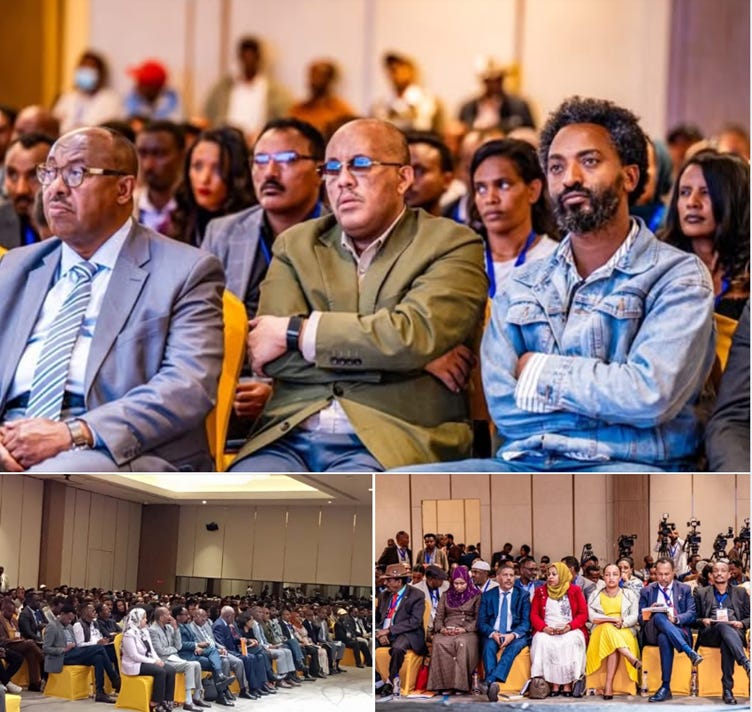
The dialogue initiative, formally anchored in the Ethiopian National Dialogue Commission and accountable to parliament, has occupied center stage for the past two years. It has its own structure, mandate, and stated objectives. At its helm is Mesfin Araya, a psychiatrist by profession and a figure of calm authority. Soft-spoken yet deliberate, he appears to approach the task with seriousness and conviction. When he speaks of healing, reconciliation, and national renewal—he commands attention and conveys a sense of purpose.
Yet, beneath the stated goals lies a persistent question: are the objectives of the dialogue entirely transparent? Beyond the declared mission of reconciliation, many suspect a deeper, unspoken agenda. There is a growing belief in some quarters that the process may serve as a subtle pathway toward constitutional reconfiguration—perhaps even a shift in the system of governance, from a parliamentary to a presidential model, and a recalibration of federalism in line with the thinking of the Prosperity Party.
Whether these concerns are grounded or speculative, the official narrative remains clear: the dialogue seeks to reconcile Ethiopians, address long-standing structural challenges, and lay the foundation for a more cohesive and stable state.
In principle, there is little to contest in the idea of a national dialogue. Ethiopia is not alone in pursuing such a path; other nations have employed similar mechanisms to confront deep-seated divisions and reset their political trajectories. Nor is there reason to question the suitability of Professor Mesfin to lead such an effort.
The difficulty arises, however, when the dialogue is viewed from the vantage point of Tigray.
Tigray today is a region profoundly scarred by war. Its social fabric remains strained, its economy battered, and its people—many of them displaced—continue to endure precarious conditions. Large segments of the population live in makeshift shelters; others remain cut off from stable livelihoods. Questions of territory, rights, and basic services remain unresolved. Even the Pretoria Agreement, which offers only minimal guarantees, is yet to be fully implemented.
Against this backdrop, a fundamental question arises: is Tigray in a position to participate meaningfully in a national dialogue? And if it is not, can outcomes reached in its partial or weakened absence truly claim national legitimacy?
At present, consultations are underway involving individuals of Tigrayan origin in Addis Ababa. Among them are figures such as Getachew Reda, Kindeya Gebre-Hiwot, and Keria Ibrahim, alongside others drawn both from the capital and, reportedly, from Tigray itself. Yet, the basis of their participation remains unclear. Are they formally mandated representatives? Were they elected or delegated by a legitimate authority? Or are they, in effect, self-selected participants?
If the latter, the process risks creating the appearance of inclusion without its substance.
This leads to a deeper concern. Is it prudent for individuals of Tigrayan origin to engage in such consultations at a time when Tigray lacks representation in federal institutions—most notably in the House of Peoples’ Representatives and the House of Federation? I am inclined to think not. And this for two reasons.
First, the absence of institutional representation deprives Tigray of an authoritative voice in national deliberations. Second, the fundamental rights of the region remain unaddressed; even the limited provisions of the Pretoria Agreement have yet to be honored in full.
Participation under such conditions may serve to enhance the image of the dialogue as inclusive and non-discriminatory. But that benefit accrues primarily to the organizers and sponsors of the process—not to Tigray itself.
For Tigray, the calculus may be different. It may be wiser, at least for now, to stand aside and allow the dialogue to proceed without lending it premature legitimacy. People grappling with displacement, insecurity, and unresolved grievances are hardly in a position to negotiate their future on equal footing, and as if the people of Tigray are on the same level of suffering as other people in the country. In short, they are not well placed to engage meaningfully in a process whose credibility, I reckon, in the majority of Tigreans, remains in question.
In the end, the issue is not the value of dialogue itself, but the conditions under which it is conducted. Without parity, preparedness, and genuine representation, participation risks becoming symbolic rather than substantive—and, perhaps, consequential in ways that are not easily reversed.