
🔖𝙏𝒊𝙜𝒓𝙖𝒊 𝑾𝙚𝒆𝙠𝒍𝙮 𝘿𝒊𝙜𝒆𝙨𝒕

𝓔𝒏𝓭𝒊𝒏𝓰 February 9, 𝟐𝟎𝟐6
𝐴 𝑏𝑙𝑜𝑔 𝑤𝑜𝑣𝑒𝑛 𝑤𝑖𝑡ℎ ℎ𝑢𝑚𝑎𝑛-𝑐𝑒𝑛𝑡𝑒𝑟𝑒𝑑 𝑠𝑡𝑜𝑟𝑖𝑒𝑠, 𝑜𝑏𝑗𝑒𝑐𝑡𝑖𝑣𝑒 𝑖𝑛𝑠𝑖𝑔ℎ𝑡𝑠, 𝑎𝑛𝑑 𝑜𝑟𝑖𝑔𝑖𝑛𝑎𝑙 𝑝𝑒𝑟𝑠𝑝𝑒𝑐𝑡𝑖𝑣𝑒𝑠 —𝑧𝑜𝑜𝑚𝑖𝑛𝑔 𝑖𝑛 𝑜𝑛 𝐓𝐢𝐠𝐫𝐚𝐢 𝑤𝑖𝑡ℎ𝑖𝑛 𝑡ℎ𝑒 𝑤𝑖𝑑𝑒𝑟 𝐄𝐭𝐡𝐢𝐨𝐩𝐢𝐚𝐧 𝑐𝑎𝑛𝑣𝑎𝑠.
Dear Readers,
In this collection, I have addressed five topics, with the fifth serving as an addendum. The first four focus on high-level political developments, referencing statements or writings by Gedion Timothewos, Prime Minister Abiy Ahmed, Seeye Abraha, and Getachew Reda. Their recent interventions prompted me to reflect and step back into recent history, validating their points and providing context.
I hope you will find these pieces insightful, and I warmly welcome your feedback.
—-
1. Material Admissions and Joint Criminal Responsibility in the Tigray War
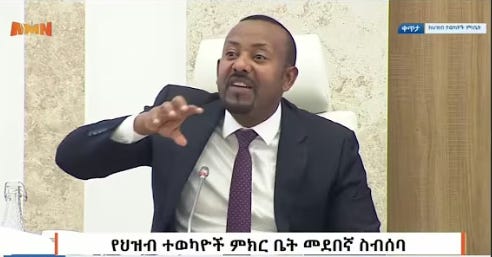
The Prime Minister’s parliamentary address of 3 February contains statements that constitute material admissions relevant to the commission of international crimes during the war in Tigray.
In that address, the Prime Minister stated that Eritrean forces operated in close proximity to Ethiopian troops and engaged in widespread looting and massacres of civilians in Shire, Adwa, Axum, and Adigrat. He explicitly acknowledged that a massacre occurred in Axum and described the dismantling of a pharmaceutical factory in Adigrat as a precipitating incident that nearly resulted in armed confrontation between Ethiopian and Eritrean forces.
These statements directly contradict the Prime Minister’s earlier public declarations. In his address to parliament on 30 November 2020, he categorically denied that any civilian harm had occurred, asserting that “not a single person was killed.” On that same occasion, and repeatedly thereafter, he publicly and profusely praised Eritrean forces for their role in the war, stating that success would not have been possible without them.
This contradiction is not incidental. It reflects a sustained pattern of denial followed by partial admission once the factual record became impossible to suppress.
The February 3 statements appear designed to reframe responsibility by attributing atrocities exclusively to Eritrean forces while portraying the Ethiopian government as a corrective actor that objected to looting and killings. This framing seeks to distance the Ethiopian state from criminal responsibility and reposition the Prime Minister as aligned with the interests of the Tigrayan civilian population.
That effort fails as a matter of law and fact.
It is a matter of public record that Ethiopian federal forces and Eritrean forces fought as a coalition and operational partners throughout the war. Their coordination was neither incidental nor ad hoc; it was strategic, sustained, and repeatedly acknowledged by the Prime Minister himself. The relationship involved invitation, joint operations, logistical facilitation, intelligence sharing, and political endorsement at the highest level.
In such circumstances, attempts to isolate responsibility are legally untenable. Where forces operate jointly, responsibility attaches jointly. Attribution of crimes to one actor does not absolve another who enabled, facilitated, coordinated with, or failed to prevent those crimes. The Prime Minister cannot extricate himself, his government, or the Ethiopian state from liability by reallocating blame to a partner force.
Even accepting the Prime Minister’s account at face value, his admissions establish knowledge of atrocities, proximity and coordination between forces, and failure to prevent or halt crimes—elements directly relevant to doctrines of command responsibility, aiding and abetting, and joint criminal enterprise under international criminal law.
Moreover, the Prime Minister has remained silent on atrocities committed by Ethiopian federal forces, despite extensive documentation. The Mahbere Dego massacre, recorded on video and independently verified, constitutes direct evidence of extrajudicial killings by Ethiopian troops. Numerous comparable incidents across Tigray are similarly documented.
The 3 February address, therefore, does not serve as exculpation. It functions instead as corroboration—a partial admission that strengthens the evidentiary record concerning mass atrocities committed during the war in Tigray and reinforces the impossibility of separating responsibility among coalition partners.
2. When Seeye Abraha Breaks His Silence: War, Responsibility, and a Clarion Call for Wisdom.
Seeye Abraha rarely steps into the public arena for interviews. When he does, it invariably commands wide attention and anticipation. During the war, he may have appeared three or four times at most. Since the signing of the Pretoria Agreement, this appears to be only his second public interview.
As a veteran of the armed struggle, a former Minister of Defence, a senior political figure within the TPLF/EPRDF, and a man known for clarity of expression and strong oratory, Seeye’s interventions merit close attention. He is also intellectually well-groomed—a graduate of Harvard University—and professionally seasoned, having served for seven years as a security adviser to UNDP in Liberia.
Typically, Seeye speaks in a calm, elder statesman’s tone. He avoids apportioning excessive blame to any single party, preferring instead to advocate reconciliation, mutual listening, and an appeal to the common good. He has consistently preached the virtues of democracy, respect for divergent views, and warned—often presciently—about the uncontrollable consequences of war once unleashed.
This time, however, his tone was markedly different.
In his interview with Axumite Media earlier this week, Seeye lambasted the Tigrean ruling party and senior military commanders in Tigray with unusual severity. He did not shy away from naming individuals—generals whom he himself had once commanded as mid-level officers during the armed struggle, or later as Defence Minister in the formal military structure. His criticism was unrestrained.
He railed against the very idea of war—regardless of justification—and against any political or strategic proximity to the Eritrean government, toward which he harbors a deep and visceral antipathy. On this point, Seeye has never wavered. Indeed, he himself was a casualty of history in this regard: unable to dismantle the regime of Isaias Afwerki or decisively degrade Eritrea’s military capacity during the 2000 war, primarily because the late Meles Zenawi did not allow it to happen.
One argument Seeye advanced—articulated with particular clarity and in a manner somewhat less common among Tigrean political figures—is his insistence that Tigrean politicians, wherever they may be positioned, must work closely with the Federal Government. He argues that they should pragmatically navigate residual hostility within federal power structures and treat engagement with Addis Ababa as the sole viable political avenue.
In his view, whether the objective is the restoration of Western Tigray, the rehabilitation of the region, or broader political recovery, Tigray must “peddle” to the Federal Government—extracting as much as it can through negotiation, persistence, and political maneuvering.
This is not, in itself, an unreasonable proposition. It is a pragmatic approach—choosing, as the saying goes, between the devil and the deep blue sea. However, such advice cannot stand on principle alone. It requires elaboration, specificity, and a clear roadmap. Without details on how, with what leverage, and at what cost, the recommendation remains incomplete.
As ever, the devil lies in the details.
3. The ‘Truth’ in the Foreign Minister’s Statement - Let us Seize Upon it!
Just a few days ago, on 7 February, Ethiopia’s Foreign Minister, Gedion Timothewos, issued a written statement formally addressed to an unnamed “Excellency,” but copied to—and therefore effectively directed at—his Eritrean counterpart. On any reasonable reading, the statement was intended for the Eritrean Foreign Minister.
In it, Gedion levels two major accusations against Eritrea. First, that Eritrea has occupied territories in north‑eastern Ethiopia for a considerable period of time; and second, that it has supported armed elements operating along the border to undermine Ethiopia’s peace and security. By “north‑eastern Ethiopia,” the statement refers to areas such as Badme, Adi‑Tseser, Geza Tegaru, and surrounding localities within the Badme Triangle.
This accusation sits uneasily with the posture adopted by Prime Minister Abiy Ahmed upon coming to power. He wasted little time in endorsing the Hague Arbitration Award, presenting himself as progressive, law‑abiding, and respectful of international legal decisions.
Many Ethiopians—including myself—reject that ruling as a travesty of justice. The Hague decision resurrected colonial treaties while sidelining the more substantive and widely accepted principle of effective administration. Moreover, Eritrea, as is now widely acknowledged, has occupied territories far beyond those purportedly awarded to it under that decision.
As an Ethiopian—and specifically as a Tigrean—I seize upon what Abiy has now said through his foreign minister. The admission that Eritrea has occupied territory in Tigray and Afar is significant. Regardless of Abiy’s prior positions or motivations, what is favorable to us must be seized and acted upon.
The Prime Minister’s broader intention may well be to construct a case for confronting Eritrea militarily or politically. That is not the immediate concern. What matters is that Abiy has now departed from his earlier assertion that Eritrea was operating strictly within its legitimate boundaries.
Eritrea must withdraw from Tigrayan—and Ethiopian—territory.
At the same time, if Abiy is contemplating—as some of his loyalists repeatedly suggest, and some activists allege—that territorial concessions in Tigray, including parts of Western Tigray, might be traded to Eritrea in exchange for access to Assab, such a move would be firmly resisted. Any access to the sea must be pursued through persuasion and diplomacy, not through the surrender of core territories in the Ethiopian hinterland.
Assab, if it is to be obtained, must not come at the price of Tigrayan land.
4. Why Getachew Writes Now? Foreshadowing the End of Tadesse Worede’s Term
This weekend, Getachew Reda, former President of the Tigray Interim Administration, published a detailed article in Fortune titled “Tadesse Worede Steers a Wounded Region into Crisis of Power, Plunder and Betrayal.” In his characteristically incisive style, Getachew portrays General Tadesse Worede, current President of the Interim Administration, as a Machiavellian, self-interested, vain, and highly ambitious leader, intent on plunder and political manipulation.
According to Getachew, during peak tensions between TPLF hardliners and the Presidency, Tadesse publicly presented himself as a neutral mediator but in fact undermined the Interim Administration, weakening its authority while appeasing hardliners who sought to render the region ungovernable. By calling for a halt to appointments and dismissals, he effectively treated the TPLF as if it had a legal right to dictate executive decisions, deliberately supporting hardliners’ interests. No senior TDF leader acted without his knowledge. Moreover, delegating authority over investment and land administration to Tadesse inadvertently placed two of the Administration’s most sensitive and corruption-prone sectors under the control of someone actively subverting it.
Getachew’s piece carries two key layers. On one level, it is a personal expression of remorse for allowing Tadesse to retain power and for doing whatever he could in the circumstances. On another level, it is a historical record, depicting Tadesse’s character and conduct for posterity.
However, the piece also carries three subtle undertones:
Getachew portrays Abiy as having played only a minimal role in Tadesse’s appointment, suggesting that Tadesse advanced through his own schemes and alliances with hardline TPLF elements. Yet this interpretation is questionable; it seems more likely that Abiy found Tadesse convenient—either as a disposable tool or as a leader whose lack of ambition and effectiveness would serve to weaken Tigray further.
The timing of the article, nearly a year after Getachew’s ouster, is notable. With Tadesse’s one-year term nearing its end—only seven weeks away—Getachew may be foreshadowing Abiy’s possible decision to replace him, signaling that Abiy has grown dissatisfied with Tadesse’s performance in light of the eight points signed by him, or finds him insufficiently compliant. This echoes previous critiques, such as those by Tsadakan, who also described Tadesse as vain, self-serving, and detrimental to governance.
3. Getachew has never been highly rated for decision-making or assertiveness in advancing his agenda. He is generally permissive, often compromising his decisions in deference to others. Even when he had clarity on key matters—such as holding the ruling party and Tigrayan leaders accountable for the conduct of the war, or advocating for separation between party and government—he failed to build sufficient constituency or push his agenda with vigor.
One clear example, as highlighted in his article this past weekend, is his failure to remove Tadesse Worede in time. By the time he acted against certain generals (though not Tadesse), it was too late—and instead, he himself was removed.
In sum, Getachew’s article is both a personal reckoning and a political warning, highlighting Tadesse’s undermining of Tigray’s administration while subtly predicting shifts in federal strategy as his term concludes.
5. Celebrating Guuesh’s Release, Calling for Berhane’s Justice
After several weeks in detention, General Guuesh Gebre has finally been released on bail of around 60,000 birr. This is welcome news—something many of us have long awaited. Guuesh never belonged in prison; on the contrary, he deserves medals and special honours for his service.
Yet we remain in Tigray, where justice is still tenuous. The charges against Guuesh were clearly weak. His imprisonment appears motivated not by any legitimate crime but by fear of his independence and principled stance, or, at worst, apprehension over his continued presence in Mekelle, near the very army he once commanded and earned widespread respect.
Guuesh had long been absent from army leadership, making allegations that he plotted against the TDF untenable. He was acting as a private citizen; claims of subversion simply do not hold water.
At least we can now celebrate that Guuesh Gebre is free and able to move about as a citizen. Yet justice must also extend to others, including Berhane Gebregergish, nicknamed “Lifeatey” (ልፍዓተይ።), who remains detained. Due process must apply to Berhane, the activist who recently turned against the TPLF, and who was himself previously released from prison months ago through the intervention of a general. It is a striking example of two sides of history applying to the same individual—one moment rescued, the next restrained—underscoring the urgent need for consistent and impartial justice.
“In it, Gedion levels two major accusations against Eritrea. First, that Eritrea has occupied territories in north‑eastern Ethiopia for a considerable period of time; and second, that it has supported armed elements operating along the border to undermine Ethiopia’s peace and security. By “north‑eastern Ethiopia,” the statement refers to areas such as Badme, Adi‑Tseser, Geza Tegaru, and surrounding localities within the Badme Triangle.”
I’m not sure if I agree with this statement. Unless I’m lacking some insider information, rather than Badme(and EEBC-ruling awarded areas), it seems to me that they’re referring to Eritrean forces being present in undisputed territories within Tigray. Sort of saying Eritrean forces are supporting TPLF by arming it and possibly training it? Either that or they’re accusing Eritrea of controlling areas south of Zalambessa.