
🔖𝙏𝒊𝙜𝒓𝙖𝒊 𝑾𝙚𝒆𝙠𝒍𝙮 𝘿𝒊𝙜𝒆𝙨𝒕

𝓔𝒏𝓭𝒊𝒏𝓰 December 21, 𝟐𝟎𝟐𝟓
𝐴 𝑏𝑙𝑜𝑔 𝑤𝑜𝑣𝑒𝑛 𝑤𝑖𝑡ℎ ℎ𝑢𝑚𝑎𝑛-𝑐𝑒𝑛𝑡𝑒𝑟𝑒𝑑 𝑠𝑡𝑜𝑟𝑖𝑒𝑠, 𝑜𝑏𝑗𝑒𝑐𝑡𝑖𝑣𝑒 𝑖𝑛𝑠𝑖𝑔ℎ𝑡𝑠, 𝑎𝑛𝑑 𝑜𝑟𝑖𝑔𝑖𝑛𝑎𝑙 𝑝𝑒𝑟𝑠𝑝𝑒𝑐𝑡𝑖𝑣𝑒𝑠 —𝑧𝑜𝑜𝑚𝑖𝑛𝑔 𝑖𝑛 𝑜𝑛 𝐓𝐢𝐠𝐫𝐚𝐢 𝑤𝑖𝑡ℎ𝑖𝑛 𝑡ℎ𝑒 𝑤𝑖𝑑𝑒𝑟 𝐄𝐭𝐡𝐢𝐨𝐩𝐢𝐚𝐧 𝑐𝑎𝑛𝑣𝑎𝑠.
Dear Readers,
I have chosen three timely topics for your reading, all of which relate to Tigray this week. I trust you will find them interesting and informative enough. Moreover, you will find them thought-provoking.
💔Hitsats: The Recurring Scourge of Man-Made Famine
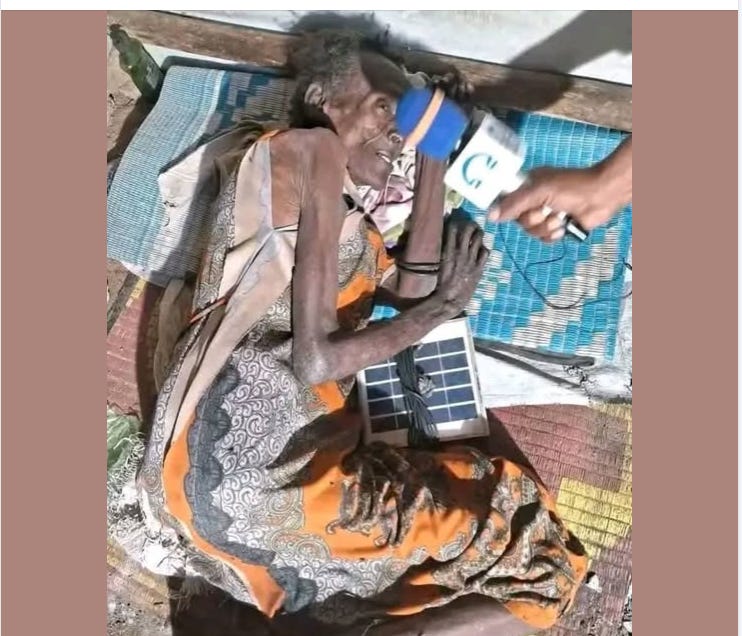
The tragic reports of emaciation and deaths emerging from the Hitsats Humanitarian Makeshift Camp amount to nothing less than a human disaster. Hitsats lies in north-western Tigray, in Asgede-Tsimbla Woreda—the very district where the TPLF was founded in 1975, just a short distance from Dedebit. The symbolism is as stark as it is painful.
Tadese Worede convened an urgent cabinet meeting this morning, a development covered in the news. The crisis unfolding in Hitsats, however, is neither sudden nor isolated. This famine—entirely human-induced—has been moving from place to place. It ravaged Abergele in south-eastern Tigray and has now surfaced at the opposite end of the region. There is little doubt that other pockets, less visible and less reported, are suffering conditions scarcely better.
What makes this moment especially obscene is the contrast. This is a time when immense wealth is on open display—in cities and beyond—and when significant sums of money circulate freely. In north-western Tigray itself, many fortunes are intertwined with the gold rush in the very same area. Ironically, this is land where gold is being extracted almost at will, where billions of birr—perhaps even dollars—are being harvested.
And yet, in the midst of this abundance, the young, children, and the elderly are silently starving, sliding toward death without spectacle or alarm. Outrageous hardly suffices; obscene, perhaps closer; morally deranged may be closer still.
Famine does not arrive overnight. It advances through stages—each one visible, each one detectable, each one reversible if acknowledged in time. That raises a disturbing question: why has the Tigray regional administration has not foreshadowed in its stark form beyond the generalities that “people are suffering in the makeshifts”? Why was the alarm not sounded earlier? Why was the public not mobilised?
More troubling still is the dissonance in official messaging. Just two days ago, the TPLF website carried a news item announcing that “a platform for the preparation of a training of the north-western zone” was underway. The title itself was opaque, almost surreal. The images showed hundreds of people seated in neat rows—apparently in Shire, just near Hitsats—engaged in evaluating past targets and performance. One is compelled to ask: what targets, and what performance, can possibly matter when human dignity and the right to live are being extinguished only kilometres away?
Several organisations have now issued statements calling for urgent action. The EPRP’s declaration was measured, humane, and to the point. Simret has also spoken out. One hopes this moment will galvanise the human spirit and prompt immediate, collective action.
But time is not a luxury we possess.
Emergency relief is essential, but it is not enough. These people must be returned to their homes—the homes from which they were driven by a war of extermination. That requires not only humanitarian response but political will, and an escalation of diplomatic pressure at both national and international levels.
Anything less would be a betrayal—not just of history, but of humanity itself.
General Kinfe’s Interview: Disowning the House After Living in It
There is something deeply jarring—almost disorienting—about hearing senior figures who once governed Ethiopia now describe it as a “toxic” project, a failed experiment, an empire not worth salvaging. This is not coming from marginal voices, but from generals and former officials who spent years at the very centre of power—often in Addis Ababa, in the citadel of the state.
When such figures speak this way, one cannot help but pause. Not out of shock, but out of disbelief.
You were there. You presided over the system. You defended it, celebrated it, and assured the country—and the world—that it was not only functional but exemplary. You told us Ethiopia had devised a political arrangement others should learn from: a constitution that placed nations and nationalities at its core, even granting the right to secede. You projected confidence that grievances had been addressed, freedoms expanded, and stability secured.
If all of this has not worked, one must ask: where were you while it was happening?
The truth is less flattering. There was complacency—born of overconfidence and self-belief. A conviction that the system was settled, that dissent had been resolved, that Ethiopia was secure in its new dispensation. Meanwhile, the system was being hollowed out. Power-hungry actors learned how to game it, skim it, and exploit it—often on the backs of a majority. And those who now decry the outcome did little to correct the course while they still had the authority to do so.
Worse still, when the moment of reckoning arrived, there was no serious negotiation—only flight. Retreat into constituencies. A squandering of hard-earned camaraderie and shared purpose. Instead of unity, there was bickering: military versus security, rival camps pulling in different directions, all while the house was burning.
Now, from the ‘‘injured’’ or ‘‘self-injured’’ conception of a country or empire comes a new agenda: that Tigray should align with Eritrea; that Ethiopia itself is not a viable project.
This is the context in which General Kinfe Dagnachew—former head of METEC, imprisoned for over five years under Abiy Ahmed—has been speaking on the Birahke show. His words may resonate with some, but they demand scrutiny, especially given the weight of the past he carries with him.
To be clear, I am not shocked by calls for Tigray’s independence. After what the region has endured, such sentiments are understandable. Emotions have been sharpened by trauma, and thousands of young people died between 2020 and 2022 crying out for independence as they fell. That sacrifice deserves respect—whether one ultimately agrees with the cause or not.
I am far more at ease when such arguments come from the young—those without the baggage of authorship, those arriving at conclusions through lived suffering rather than retrospective rationalisation.
As General Abebe Tekle-Haymanot rightly observed in an interview last year, the question of independence must be judged on two grounds: whether it carries more merits than demerits, and whether it is realistically achievable. These are not slogans; they are tests.
For now, however, our focus must be elsewhere. The present is crowded with urgent, suffocating realities—humanitarian collapse, displacement, economic strangulation, political uncertainty. This is a moment to win the sympathy of the world, to rebuild bridges with brothers and sisters across the country, and to allow the dust of war to settle.
Questions of independence—or any other far-reaching political rearrangement—can wait. If they are viable, they will remain so when wounds have healed. If they are not, no amount of urgency today will make them so.
As for General Kinfe and other veterans of the TPLF, I would rather see them turn to reckoning than agenda-setting: to write honestly about the epic struggles, the errors, the sins, and the regrets of the past. There is value there—human value. What we do not need now are new distractions, born less of necessity than of unrepenting self.
History is demanding reflection, not escape.
Relief Long Overdue: Debt, Protocol, and Tigray’s Place
We have recently seen General Tadesse Worede engaging officials of the Commercial Bank of Ethiopia in Addis Ababa—reportedly with Vice President Ephrem Mekuria—on the question of relieving Tigrayan businesses from the crushing burden of accumulated debt. These are loans taken long ago by enterprises that were subsequently frozen, located in active war zones, or whose owners were forced to flee for their safety. Yet throughout this period, both principal and interest continued to accrue, and the banks—chiefly the CBE—are demanding repayment as though nothing extraordinary had occurred.
Two observations arise when one looks at this matter carefully.
First, the timing is striking. The Pretoria Agreement was signed more than three years ago. Yet until now, we have heard little—at least officially—about structured efforts to address the debt overhang suffocating Tigrayan businesses. This silence itself warrants reflection.
Second, there is the question of protocol and institutional standing. A regional president—whose constitutional and political status is comparable to that of a deputy prime minister—travelling to Addis Ababa with his team to engage a vice president of a single bank is not a trivial detail. It signals a troubling asymmetry. Twenty-five years ago, Gebru Asrat, president of the regional state of Tigray, would have been received by federal ministers as their superior, and an audience with him would have been sought rather than requested. That shift in posture is difficult to overlook.
That said, the effort itself is welcome. It is encouraging to see General Tadesse opening new fronts of engagement and expanding the domain of advocacy beyond the purely political and security spheres. This is necessary, and it is long overdue. But engagement must also be anchored in mutual respect and institutional parity. After all, this is not a personal petition—it is a matter concerning an entire region.
Good read again, though on tough subjects to handle. You have been modest in your critique on the horrors of HiTseTs. It is deplorable, criminal and the politico-militray gang need to be held responsible. It is encouraging to see ordinary citizens, particularly the youth moving fast to save lives.
Perhaps other forms of organizing (civil society) could replace the dysfunctional state, at least during emergency. So we should think broadening and strengthening them.
On independence and Gen. Kinfe: it is very important, from the get go, to differentiate between those who truly believe in the cause for independence, organized around the idea and publicly campaigned for it when it was Haram! Kinfe and the TPLF gang on the other hand are merchants who are trying to salvage their political life tucking themselves (like a leech) to the independence movement. These transcationalists shouldn't be allowed to murky the waters. It is duty of an astute writer like you to make sure these two are not seen lumped together, even for an outside observer.