
🔖𝙏𝒊𝙜𝒓𝙖𝒊 𝑾𝙚𝒆𝙠𝒍𝙮 𝘿𝒊𝙜𝒆𝙨𝒕

𝓔𝒏𝓭𝒊𝒏𝓰 January 25, 𝟐𝟎𝟐6
𝐴 𝑏𝑙𝑜𝑔 𝑤𝑜𝑣𝑒𝑛 𝑤𝑖𝑡ℎ ℎ𝑢𝑚𝑎𝑛-𝑐𝑒𝑛𝑡𝑒𝑟𝑒𝑑 𝑠𝑡𝑜𝑟𝑖𝑒𝑠, 𝑜𝑏𝑗𝑒𝑐𝑡𝑖𝑣𝑒 𝑖𝑛𝑠𝑖𝑔ℎ𝑡𝑠, 𝑎𝑛𝑑 𝑜𝑟𝑖𝑔𝑖𝑛𝑎𝑙 𝑝𝑒𝑟𝑠𝑝𝑒𝑐𝑡𝑖𝑣𝑒𝑠 —𝑧𝑜𝑜𝑚𝑖𝑛𝑔 𝑖𝑛 𝑜𝑛 𝐓𝐢𝐠𝐫𝐚𝐢 𝑤𝑖𝑡ℎ𝑖𝑛 𝑡ℎ𝑒 𝑤𝑖𝑑𝑒𝑟 𝐄𝐭𝐡𝐢𝐨𝐩𝐢𝐚𝐧 𝑐𝑎𝑛𝑣𝑎𝑠.
Today, I am writing from Addis Ababa. I was in Mekelle for four days and saw things from close up. Most of today’s writing is from direct personal experience while I was in Mekelle.
I hope you will enjoy the reporting and reflection. Please send your feedback, and hope you will connect me to new subscribers.
1. Mekelle Today: From the Pulse of Timket to the Weight of Recovery
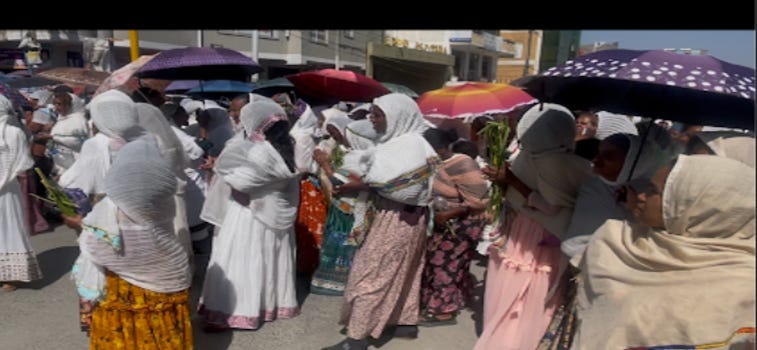
I have personally witnessed the Timket procession of the laity in Mekelle. The long, multi-file stream of people—from around Romanat Square all the way to the CBE regional headquarters, perhaps stretching some three hundred metres—dancing, chanting, beating drums, and moving in seamless festive rhythm, was heart-warming. The otherwise struggling city suddenly burst into life with the Epiphany celebration.
This Tuesday and Wednesday, I walked through Mekelle for hours, hoping to relive memories of a life once well-lived, and to gauge the present mood of the city, if only from a cursory glance. I did not encounter nearly as many people as I used to in the past, when one could hardly move without jostling into familiar faces. This time, it was different. I even visited the city’s hubs and hotels, hoping to meet people there. Unfortunately, the hotels were almost empty—despite it being January, a time when spirits are usually high with weddings and the end of the fasting season. My stay was too short to engage with many people, even if that had been possible.
Mekelle today looks like a dishevelled person—or like a household compound poorly kept: dust here, twigs there, cardboard scattered about, pebbles in the corners, and so on. The advertising placards are poorly placed, shoddy, and oversized. The newly asphalted roads are smooth and relatively well built, but they lack proper walkways for pedestrians. The small three-wheeled taxis (bajaj) are now largely out of sight in the city centre, which has given Mekelle a semblance of order—but that alone is far from sufficient. What one senses everywhere is a great, unmet demand for orderliness, cleanliness, and truly urbane features.
I heard that Atse Yohannes Palace is undergoing a major facelift with funding from the Federal government, with construction taking place in the backyard of the palace complex. That is not a bad initiative, provided it does not overwhelm the historic front building. Beyond that, however, I did not notice many new structures or significant developments.
The most disheartening story I heard concerned the low attendance of students in schools. A teacher I met told me that many students are no longer in the mood to attend classes, weighed down by the burdens of the past—expressed in trauma—and by a deep hopelessness about their future. In a classroom allocated for fifty students, he said, one would find barely a tenth of that number actually attending. Even if we assume my narrator exaggerated, anything significantly higher—say, even half the class—would still be profoundly troubling, particularly in a region where education has traditionally been held in the highest regard.
Considering where Mekelle is coming from—a city at the heart of a war that devastated all of Tigray—Mekelle is, in a narrow sense, okay. Credit is due to the Pretoria Agreement for halting the destruction. But in terms of recovery and positioning itself for the future as the country’s second-largest city, Mekelle is already showing signs of being left behind by other towns. More troubling still, its residents do not feel the sense of stability one might have expected after the guns fell silent. Many well-resourced and informed people have already migrated to Addis Ababa and elsewhere, as Mekelle no longer promises strong economic prospects for the future.
It is striking to observe that the very moment one steps into Addis Ababa from Mekelle, one is seized by the feeling of having entered a megacity somewhere in Europe or the developed world. Addis and Mekelle appear like cities belonging to two different countries, situated at entirely different levels of development. The disparity between them is not merely visible; it is yawning and unsettling. While the transformations in Addis are breathtaking—indeed, far beyond what one might once have imagined possible—the stagnation of Mekelle, and in some respects its regression, sends a chill down the spine.
2. Resource Mobilisation Through Increased Prices – Will That Cover the Deficit?

Early this week, Abreham Tekeste, a member of the TPLF Executive Committee and a person claiming to be the chair of the Board of Directors of EFFORT (which has been de-legitimized by the courts), issued an announcement. According to him, a margin will be added to several commodities in Tigray, including beverages—a category often targeted for such measures—to generate resources to cover shortfalls caused by the “reduction of the budget by the Federal Government.”
In plain terms, the Tigrayan Interim Government is not currently in a position to run the machinery or maintain operations with diminished federal resources. Putting aside the confusing question of Abreham’s capacity to make such an announcement, there is a more pressing issue: the financial mechanics and consequences of this move.
The situation in Tigray has long been dismal from a budgetary perspective. The federal government appears to be tightening every channel it perceives as a source of revenue for the regional government, while relations remain dysfunctional. But the key questions are: how much revenue is the regional government realistically attempting to raise with these commodity margins? How will price elasticity affect outcomes? Higher prices typically reduce demand in volume terms, depending on how price-sensitive a commodity is. Moreover, what are the long-term effects? Will not prices remain elevated even after this measure is lifted, particularly once the government formalizes or endorses them?
It is a tricky situation. What worries me further is whether the revenue generated through these price increases will be meaningful. I am skeptical. Other potential sources of finance need to be explored extensively. Why not mobilize private resources through NGOs or international aid agencies? Why not appeal to the Diaspora through its various organizations?
Of course, engaging the Diaspora is complicated. Many in the Diaspora remain wary because large sums raised in the past were never audited, and Debretsion and his allies actively prevented transparency. Without accountability, it is unlikely to entice the Diaspora to contribute again.
I sincerely hope the regional government has carefully done the math behind this plan. My assessment, however, is that the proposed price increases will likely generate only a small fraction of the resources needed.
3. General Gu’ush Still Wallowing in Detention: Let Due Process of Law Prevail!
Gu’ush Gebre remains the focal point of discussion and concern this week in Mekelle and among Tegaru communities elsewhere. His reputation rests on two pillars: first, the gallant defense of Adigrat, which earned him mass respect and admiration; and second, his principled decision last January to step away from the “Corps and Above Corps” controversy, a move that garnered widespread respect even from those who did not fully share his position. I covered these developments in detail in last week’s blog. Today, I will go straight to the latest.
A slip of paper issued by one Melaku Wolde-Tinsae alleges that Gu’ush faces three major charges: 1) collaborating with the enemy; 2) engaging in a mission to dismantle the army; and 3) insubordination to superiors. The slip states that the charges have already been lodged with a court, though it does not specify which one. It also notes that Gu’ush is to appear before the court again on 26 January 2026, nine days after his detention—a timeline that, on the surface, appears procedurally correct.
However, key questions remain. Where is he being held? He is detained not in a standard police facility but in a private residence, under the watch of military police rather than the ordinary police, the latter of which are constitutionally tied to the justice system.
Skepticism and outrage are growing, as many argue that these charges are fabricated and legally flawed. First: Who is the “enemy”? If the federal government is meant, the Pretoria Agreement makes that designation questionable. If it is Eritrea, then such matters fall under federal jurisdiction—but no one has been brought to court for working with the Eritrean regime, despite previous dealings (the so-called Tsimdo) widely acknowledged as factual.
Second: the charge of working against the army. Gu’ush apparently had already stepped away from military service, so on what legal basis is this considered an actionable offense?
Third: insubordination. As I understand it, this is primarily an administrative matter, disciplinary rather than criminal.
Tomorrow will provide clarity, though it may also reveal yet another breach of morality, fairness, and decency—a grim reflection of the undemocratic, irresponsible, and haughty character of the ruling class in Mekelle that enabled this disgrace: the incarceration of a hero. May God prevent such injustice.
4. Messebo Cement: Another Expression of a Governance Crisis
Just this week, I learned from a well-resourced individual that farmers in the surroundings of Messebo Factory in Mekelle have lodged a large claim against the company, alleging displacement and the takeover of their ancestral land without adequate compensation. As a result, the quarry supplying raw materials to the factory downstream has reportedly been halted.
They may well have received some form of compensation in the past, but a new consciousness appears to have taken hold among the peasants—one that views whatever was paid some twenty-five years ago as a trifling sum, insufficient for the loss they endured. They are now demanding fresh and fair compensation.
There is also well-founded information suggesting that the dispute between Messebo Factory and the farmers is directly linked to the power struggle between the old and the new boards of EFFORT—the two rival bodies that have been battling in court and issuing competing instructions to the management of various EFFORT companies. I conjecture that one of the boards—most likely the new board, which has been delegitimised by the court—is working clandestinely with the farmers, encouraging and tipping them off to press their claims against Messebo.
It is abhorrent that such a matter could not have been resolved amicably and instead has descended into an impasse that cripples one of the region’s major industrial establishments. This, too, is yet another symptom of a dysfunctional system—both within government and across the parastatal sector.
Thanks for your personal account of Mekelle. It vividly tells all about the dire suitation of Tigray for years to come less enabler gov't formed.